21 October 2009

US Health Impact Project launches, with opportunities for funding

The Health Impact Project today released a call for proposals to fund up to 15 health impact assessments (HIAs) at the local, state and tribal levels. HIAs are a flexible, data-driven approach that identify the health consequences of new policies and programs, and develop practical strategies to maximize their health benefits and minimize adverse effects.

Grants will range from between $25,000 and $150,000 each. Government agencies, educational institutions and nonprofit organizations at all levels of policy and program development are encouraged to apply. The call for proposals and other information about the project is available at www.healthimpactproject.org

The last two decades of health research have demonstrated the profound importance of social, economic and environmental decisions to the health of Americans. To stem the rising tide of chronic disease and create safe, thriving communities, health needs to be factored into decisions that affect the public. HIAs provide an avenue to do just that. They are a valuable tool to help government and community leaders working across all sectors-from agriculture and food production to transportation and planning-make smart decisions that lead to healthier communities.

A collaboration of the Robert Wood Johnson Foundation and The Pew Charitable Trusts, the Health Impact Project is a national initiative designed to promote the use of HIAs as a decision-making tool for policymakers.

3 October 2009

Follow us on Twitter

In addition to the HIA Blog we also regularly update our Twitter account with HIA-related news and information. Follow us at:

twitter.com/hiablog

2 October 2009

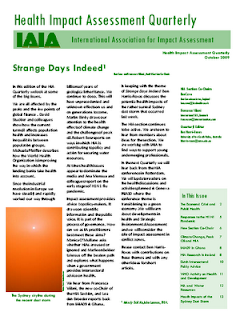
International Association for Impact Assessment Health Quarterly: Strange Days Indeed

The latest issue of the International Association for Impact Assessment (IAIA) Health Quarterly is available for download [PDF 447 Kb]:

http://bit.ly/iTOhr

This issue is on the theme of Strange Days Indeed and covers:
  • The Economic Crisis and Public Health
  • Responses to the H1N1 Pandemic
  • The New Health Section Co-Chair
  • Climate Change, Peak Oil and HIA
  • IAIA09 in Ghana
  • HIA Research in Ireland
  • Dutch Intersectoral Policy Advice
  • WHO Activity on Health and Development Lending
  • HIA and Water Resources
  • The Health Impacts of the Sydney Dust Storm
Ben Harris-Roxas
Quarterly Editor

Ben Cave and Francesca Viliani
IAIA Health Section Co-Chairs

23 September 2009

Dust Storm Envelops Sydney: What are the health impacts?

Sydneysiders awoke to a red glow this morning and opened their curtains to find that the city had been shrouded in a dust storm, blown in by strong winds last night. Our clothesline was covered in red muddy lumps that were similar in shape to the clothes I’d hung out yesterday.

My mother-in-law called up to instruct us not to take the baby outside. “You don’t want her breathing that stuff!” I’m no respiratory expert, but I know that one-off exposure to dust of this nature was unlikely to cause enduring respiratory problems. A precautionary response doesn’t hurt however, and state health agencies have recommended that people stay inside. This did make me wonder, what are the health impacts of dust storms?

Dust storms may contain plant pollens, fungal spores, dried animal faeces, minerals, chemicals from fires and industry, bacteria and pesticide residues. These all have the potential to impact on human health. This is of particular concern in countries where there is increasing desertification and weak government regulation. The potential health impacts of dust itself are important - usually by exacerbating existing asthma. Dust storms have also led to algal blooms in some parts of the world, which in turn have a number of environmental and health impacts.

The psychological impacts of dust storms are worth mentioning as well. The Welsh HIA Support Unit conducted an HIA of a coal mine in Wales and found that it wasn’t particulates alone that could impact on people’s health (they've now done several HIAs on coal mines). The constant noise and dust undermined their mental health as well. Dust storms are far less constant so the extent won’t be so great, but already I’ve noticed a flurry of exclamations about the “end of the world” amongst my friends on facebook this morning. I think that if the storm goes on for several days some of these exclamations may become semi-serious.

Dust storms remind us that what happens in the outback has a very real effect on cities, as much as we might like to pretend it doesn’t. I lived in Bourke as a kid and dust storms were not an uncommon event. Maybe they’ll become semi-regular events in the Sydney of the future as well. I’ll have to start bringing the washing in.

This post first appeared on Croakey

14 September 2009

New UNSW HIA eNews available

The latest issue of the UNSW Health Impact Assessment eNews is available for download from:

http://www.hiaconnect.edu.au/enews/HIA_eNews_22.pdf

In this issue:

Health Impact Assessment: From the Global to the Local

Community-Led Health Impact Assessment: The Goodooga Equity Focused HIA

Equity Focused HIA

HIA in North Queensland

Revamped HIA Connect Website

Western Australian HIA Network

Second Asia Pacific HIA Conference in Thailand

Second New Zealand HIA Practitioner Workshop

HIA Practice Standards Issued by North American Group

Forthcoming WHO Guide on Health in Development Lending

UNSW HIA Publications

Learning by Doing HIA Training Packages

What’s New?

3 September 2009

HIA Impact on Policy: Sign up for the Preconference workshop - S(t)imulating health advocacy in urban renewal planning

From Marleen Bekker, Erasmus MC

At the international HIA conference ‘On the move’ October 14, 2009 in Rotterdam, The Netherlands, a preconference workshop will move participants to reflect on, and build capacity in, agendasetting and policy impact for health.
As a practitioner applying Health Impact Assessment in policy or planning processes, or as a scientist studying design or outcomes of HIA, you may be wondering about how HIA actually helps to put public health issues on the policy or planning agenda. When is scientific, objective evidence the active substance for policy impact, and when are additional or alternative strategies needed? How do you actually build support, how do you establish the ‘right’ timing, and how do you gain access to the relevant networks of influential actors and decision-making procedures?

In a game simulation of a planning process concerning an urban renewal project, the participants explore those questions implicitly while playing different roles of parties and actors involved in urban renewal. Participants are specifically assigned to develop a strategy to set the political agenda for their different role priorities during the game. The health stakeholders could set the agenda for health either by developing an HIA or by other means. Participants are asked to play a different role than their own real-life one, which enables an individual frame reflection during the game. Afterwards, de-briefing and evaluating the game simulation enables cross-frame reflections, strengthening or renewing the knowledge and competence of participants in health advocacy.

The game simulations create a safe yet realistic setting for playing and practicing skills without repercussions. Efforts to set the agenda for health are put into the perspective of the full dynamics of such planning processes. In the games, the participants are confronted with different frames, interests and positions during and after the game. From the game simulations we may learn how a particular, realistic setting of urban planning induces effective and ineffective strategies from health proponents and non-health actors and stakeholders to put forward their interests in the planning process.Policy entrepreneurship, building effective coalitions and mobilizing power resources are emergent strategies that may be adopted alongside the HIA to move from evidence to action. This game simulation is unfreezing fixed frames, and moreover it is great fun!!!

For more information and for registration details, see www.hia09.nl.

Marleen Bekker

31 August 2009

Can forseeable consequences be unintended?

There is an interesting piece on Croakey about the need for a more considered planning process for the Australian H1N1 vaccination program. It spells out the need for precaution in relation to the administration of the vaccine and to not rush into repeating the mistakes of the 1976 US swine flu mass-vaccination campaign.

I'm not suggesting that an HIA would be appropriate in this case - in fact I think it wouldn't be. It does however raise some interesting points about whether potential consequences that can be foreseen (the transmission infectious organisms through multi-dose vials and Guillain-Barré syndrome are both mentioned in the piece) can ever be regarded as unintended?

Sarah Curtis wrote a fantastic article on the related issue of having to make decisions about risks as part of HIA when much of the information required to make these decisions is unknown (within the context of discussing the broader concept of risk society). As HIA practitioners we have to deal with similar issues regularly - what are your thoughts?

25 August 2009

More news on HIA in New Zealand: Funding opportunities and evaluation survey

The New Zealand Ministry of Health's HIA Support Unit has announced a new round of funding for HIAs through its learning by doing fund and a survey as part of the evaluation of the unit. More information

US EPA Graduate Fellowships, including HIA

US graduate students are eligible to apply for the US Environmental Protection Agency's Science to Achieve Results (STAR) fellowships, which include human health as one of several topic areas topic and incorporates health impact assessment. For more information go to the Star Fellowships webpage.

The closing date for applications is October 22.

15 August 2009

European Health Forum, Gastein

From Lea den Broeder

From 30 September to 3 October the annual European Health Forum will take place in Gastein, Austria.

This is a major event in Europe for all who are interested in health policy and research. This year the focus will be on the impact of the financial crisis on health and health care. What are the threats, what are the problems, but also: does the crisis provide new and unanticipated opportunities for health? Other topics will be Health inequalities, Sustainable healthcare, Health technology assessment and Transferring knowledge into action. Top speakers and workshop leaders from policy, industry and research will provide food for thought for all participants. Highly recommended!

For more info look at http://www.ehfg.org

7 August 2009

News on Health Impact Assessment in New Zealand

The New Zealand HIA eNews has come out:

In this issue, we talk about five different skills you'll use when doing an HIA - project management, relationship building, literature reviews, facilitation and report writing... Our focus on key skills is to get you thinking about your own strengths and weaknesses so you can plan to build up your skills in your weaker areas.


Access eNews

6 August 2009

IAIA UK Climate Change Adaptation and IA Conference


From Debbie Fox

The Ireland & UK Branch of the IAIA is pleased to announce the opening of bookings for its conference on:

Climate Change Adaptation Strategies and their integration into Impact Assessments

This full day event (9am – 4pm) will be held on Thursday the 8th October 2009 and is brought to you jointly by the Ireland & UK Branch of the IAIA and the Met Office. The conference will be held at the Met Office Headquarters in Exeter.

The conference will provide the latest thinking and advice on how to consider climate change adaptation in the impact assessment process. The latest conference programme can be downloaded from: http://www.iaia.org/publicdocuments/affiliates-and-branches/ireland-uk/CCAdaptation_&_IA_8Oct09v1.pdf

The day is split into three sessions providing delegates with Government, Professional, and Practitioners perspectives. Each of these sessions is designed to provide up-to-date information and guidance, they will also provide delegates with an opportunity to ask question and briefly debate key issues. Delegates will also get the opportunity to go on a tour of the Met Offices Headquarters during the lunch break to learn more about the Met Offices activities in relation to climate change.

The conference is sponsored by Golder Associates (www.golder.com) and is designed for those working or involved in impact assessment (e.g. EIA, SEA, SA, HIA, etc). The event is open to all and we encourage you to forward this email to colleagues and contacts you feel would be interested in attending the event, a poster for the event is also attached to help you promote this event on behalf of the Branch.

The costs to attend this conference are:
£65 (+VAT = £74.75) for IAIA members
£100 (+VAT = £115) for Non-members

Golder Associates have kindly agreed to process bookings for this event. To ensure your place is reserved at this essential conference call: Maxine McArdle on 01865 870 000, or email Maxine_McardleATgolder.com with the subject: IAIA_8thOct. Payment is by credit card or cheques - made payable to: Golder Associates UK.

Note: Only 45 delegate places are available at this conference and due to security restrictions at the Met Office HQ booking before the 1st September is advisable.

For further details please visit:
http://www.iaia.org/affiliatesbranches/irelanduk-branch.aspx

We look forward to seeing you at this event.

3 August 2009

Special issue of IAPA on the effectiveness of impact assessment

Impact Assessment and Project Appraisal, the journal of the International Association for Impact Assessment, has published a special issue the effectiveness of impact assessment instruments.

IA effectiveness is a pet subject of mine but I think that the issue will be of interest to any HIA professional. Though none of the articles deal with HIA specifically the issues discussed are all relevant to HIA practice, in particular Urmila Jha-Thakur's excellent article on the importance of participatory learning in SEA.

The issue includes articles on:

Introduction: The effectiveness of impact assessment instruments
pp. 91-93(3)
Authors: Cashmore, Matthew; Bond, Alan; Sadler, Barry

Effectiveness in social impact assessment: Aboriginal peoples and resource development in Australia
pp. 95-110(16)
Author: O'Faircheallaigh, Ciaran

SEA and planning: 'ownership' of strategic environmental assessment by the planners is the key to its effectiveness
pp. 111-120(10)
Authors: Stoeglehner, Gernot; Brown, A.L.; Kørnøv, Lone B.

Rationality and effectiveness: does EIA/SEA treat them as synonyms?
pp. 121-131(11)
Author: Elling, Bo

Effectiveness of strategic environmental assessment - the significance of learning
pp. 133-144(12)
Authors: Jha-Thakur, Urmila; Gazzola, Paola; Peel, Deborah; Fischer, Thomas B.; Kidd, Sue

Evaluating strategic environmental assessment in The Netherlands: content, process and procedure as indissoluble criteria for effectiveness
pp. 145-154(10)
Authors: van Buuren, Arwin; Nooteboom, Sibout

Sustainability-focused impact assessment: English experiences
pp. 155-168(14)
Authors: Therivel, Riki; Christian, Gemma; Craig, Claire; Grinham, Russell; Mackins, David; Smith, James; Sneller, Terry; Turner, Richard; Walker, Dee; Yamane, Motoko

Access the issue


Matt Cashmore, Alan Bond and Barry Sadler have done a good job guest editing the issue and I think it will make a substantial contribution to the update of the International Environmental Impact Assessment Effectiveness Study [PDF 6 Mb] that is currently underway.

28 July 2009

Blog Design Revamp

As part of our ongoing efforts to make this blog useful to you, our users, we have overhauled the design. What do you think?

Follow us on Twitter

We're now on Twitter so you can find out everything you ever wanted to know about HIA in 140 characters or less.

13 July 2009

A Review Package for Health Impact Assessment Reports of Development Projects

We are very pleased to tell you about a review package for HIA that we have just published.

The review package is intended to enable a commissioner or reviewer of an HIA report to reach an opinion as to the quality of the completed report in a simple, quick and systematic manner.

We have focused on developing a review package for HIA reports which are submitted as evidence associated with an application for development consent. We see the users of this review package as being commissioners of HIA both in the public and private sector and those who may be asked to review HIA reports.

Experience gained through using the review package will be essential to ensure that it covers all that it should, and that it continues to promote best practice in HIA. We are very interested to receive comments on this review package.

Please send comments to hiareview@bcahealth.co.uk

Ben Cave
Mette Winge Fredsgaard
Alan Bond

Download Review Package [PDF]