10 April 2006
Temporary Home for the HIA Gateway
The HIA Gateway has relocated to a temporary home, following NICE's decision to close it. You can now access it at:
www.hiagateway.org.uk


5 April 2006
US Healthy PLACES Bill calls for HIAs to be undertaken
United States senators Barack Obama and Hilda Solis announced that they would introduce the Healthy PLACES (Priorities for Living Actively in Community Environments) Act this week as part of the American Public Health Association's Designing Healthy Communities, Raising Healthy Kids week. The bill's focus is on improving urban and environmental design in order to prevent chronic disease and promote physical activity.
The bill includes measures aimed at supporting the voluntary use of HIA:
Links
Op-Ed piece by Barack Obama and Georges Benjamin about the Healthy PLACES bill
WHO Healthy Environments for Children Alliance's Framework for Action

The bill includes measures aimed at supporting the voluntary use of HIA:
Health Impact Assessments The bill would establish a program to support voluntary Health Impact Assessments (HIA). States and communities could conduct HIAs to assess the effect of major policy or programmatic changes on the health of the community. SourceThere is, of course, a huge gap (and a lot of negotiation) between a bill being introduced to the US Congress and it being passed. The fact that HIA is being discussed at a political level at all is something of an achievement however, illustrating that it's on US decision-makers' radars in some form.
Links
Op-Ed piece by Barack Obama and Georges Benjamin about the Healthy PLACES bill
WHO Healthy Environments for Children Alliance's Framework for Action
31 March 2006
Subscribe! Two ways to stay updated
In response to suggestions from you (i.e. the people who read this blog) I've added two easy ways for you to stay up-to-date:
Please keep sending in your suggestions for improvement!
- Email Notification Receive an email whenever somthing new is posted to this blog. The emails include the full content of the posts so you may never have to visit this blog again (except to comment). You can to this by entering your email address into the box on the right hand column and clicking on the subscribe button.
- Subscribing Using Feeds News aggregators can check if your favourite sites have been updated. Detailed information on how to do this is available here.
Please keep sending in your suggestions for improvement!
Update: HIA Gateway
The HIA Gateway will be unavailable while NICE are opening up their new website this week but a contact person is available for people wanting to use material on the site during the rest of this week.
NICE will establish a link between their new site and HIA Gateway URL as a temporary measure so that the site remains live to provide time for seeking an alternative provider.
NICE will set up a meeting as soon as possible to discuss the way forward for finding a new host for the HIA Gateway site.
Information courtesy of Colleen Williams from the UK Department of Health via Salim Vohra.
Related Post: HIA Gateway to Close
NICE will establish a link between their new site and HIA Gateway URL as a temporary measure so that the site remains live to provide time for seeking an alternative provider.
NICE will set up a meeting as soon as possible to discuss the way forward for finding a new host for the HIA Gateway site.
Information courtesy of Colleen Williams from the UK Department of Health via Salim Vohra.
Related Post: HIA Gateway to Close
30 March 2006
A blog post about a poster about a blog...

At the risk of being slightly too self-referential for my own good I thought you might be interested in the poster about this blog [PDF file, 1.95 Mb] that Patrick is very kindly taking to the UK and Ireland HIA Conference for me. As the poster says "despite having a number of regular visitors we have experienced difficulty in encouraging users to comment on the issues raised" so I'd be interested to hear your thougts on it! :)
The conference program is now available and it looks like there will be a number of really fascinating sessions. I'm very interested to see that so many people will be presenting on capacity building issues. At the last conference in 2004 it seemed as though there were only a handful of people engaged in system-oriented capacity building work - has there been a shift in the focus of HIA work internationally?
26 March 2006
HIA Gateway to Close
 Screenshot of NICE's announcement of the closure on the HIA Gateway
NICE has announced that the HIA Gateway will be closed at the end of March. The Gateway was one of the original and best HIA resources on the web; it's loss represents a considerable blow to the HIA community.
The notice on the Gateway says that NICE are seeking a new host for the information held on the Gateway. What are you suggestions and ideas?
A number of suggestions have already been made on the HIANET listserv including hosting the information on the South East Public Health Observatory or setting up a HIA wiki.
If you post your ideas and comments here I'll consolidate them and then distribute them on the HIANET and IAIA HIA listservs.
18 March 2006
New HIA Newsletter
There's a new HIA newsletter being put out by the Institute of Public Health in Ireland. It's a fairly low-key publication at the moment but it may be worth keeping an eye on it in future.
It's good to have a companion to our own humble HIA E-News.
It's good to have a companion to our own humble HIA E-News.
17 March 2006
Health Believers in HIA (Others Less Convinced): New Zealand survey of policy-makers' attitudes

Gaulda R, Bloomfield A, Kiro C,Lavis J, Ross S. Conceptions and uses of public health ideas by New Zealand government policymakers: report on a five-agency survey, Public Health 120(4): 283-289. doi:10.1016/j.puhe.2005.10.008
There are a number of interesting findings in the survey but the one that I find most compelling is the attitudes to making HIAs mandatory that are reported:
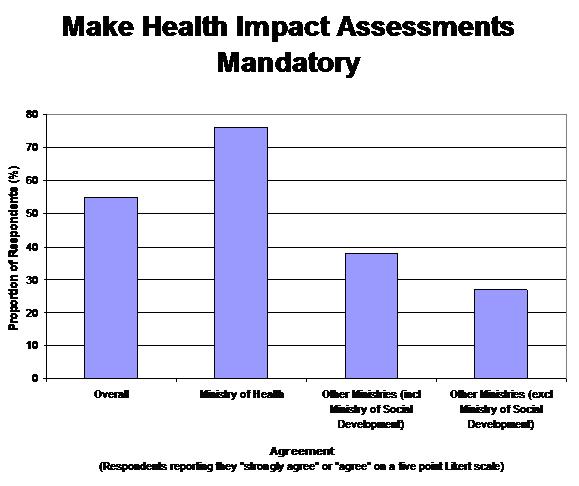
As you can see, health policy-makers are largely supportive of the ida of making HIAs madatory (76%)but policy-makers from other sectors are less convinced (38%). Support for the concept of HIAs being mandatory is further reduced when respondents from the Ministry of Social Development, probably New Zeland's largest human services ministry, are removed from the "other" catgory (only 27%).
This is quite telling becuase New Zealand has done a moderate amount of work in developing HIA and using it to assess other sectors' proposals (and it's not just government that supports its use).
I suspect that if a similar survey was done in Austalia or other countries where capacity to undetake HIA is being built there may be even less support for the idea of making HIA mandatory.
What do you think about this? I think it suggests that a softly-softly approach to involving policy-makers from non-health sectors in HIA may be more appropriate than a regulatory/mandated one.
Article Abstract
Objectives
This article describes New Zealand government policymakers' awareness of, attitudes toward and self-reported use of ideas about the determinants of health. Some comparison with an earlier Canadian study is provided.
Methods
Employees with policymaking and advisory responsibilities in government departments of health, social development, housing, education and finance were surveyed.
Results
More than half of the respondents (58%) were familiar with ideas about health determinants. Eighty percent felt that health determinants should be considered in all government policy, but that more practical information on effective policy interventions is needed. Commitment to the idea that the economy should take precedence over reducing health inequalities was low.
Conclusions
There is a demand for literature on health determinants that is sector specific and which provides practical and proven information about effective interventions that influence health.
8 March 2006
HIA Capacity Building
 I recently came across IMPACT's Capacity Building for Health Impact Assessment webpage. It's a project that brings together IMPACT, Liverpool Primary Care Trusts and the Liverpool City Council to build capacity to undertake HIA. They're doing interesting work, quite similar in nature to our NSW HIA Project.
If you're interested in some of the specifics of CHETRE's approach you can access the article on the project in the NSW Public Health Bulletin or look at the presentations I gave on the project at the 2005 IAIA conference and at the 2004 UK & Ireland HIA conference. I'm sure that IMPACT will presenting on their work at the upcoming HIA conference in Cardiff.
Building system capacity to undertake HIA is one of the primary challenges facing governments interested in utilising HIA. (more) Past experience suggests that top-down or legislative approaches requiring HIA with little prior capacity building will fail.
CHETRE has taken more of a multi-pronged approach to building capacity, drawing on the NSW Capacity Building Framework:
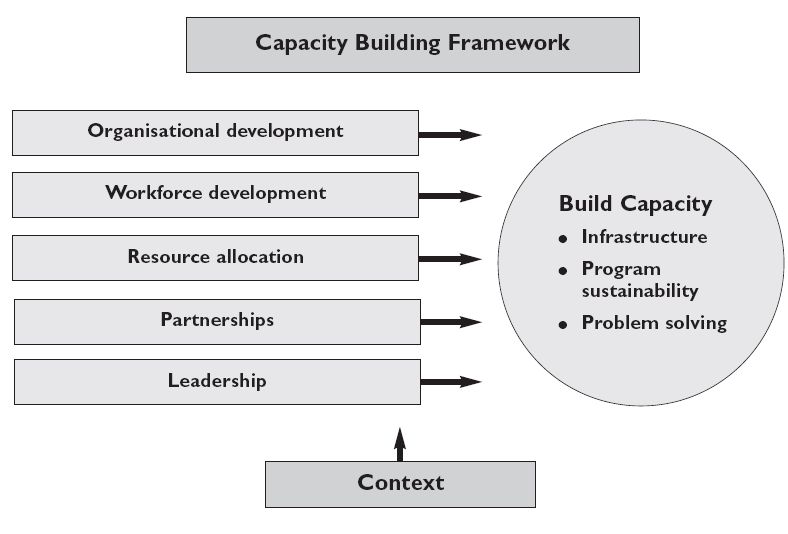
I know that IMPACT's work draws upon this approach as well.
What HIA capacity building work are you currently engaged in? What has worked and what hasn't?
16 February 2006
New Zealand Public Health Association call for wider use of HIA
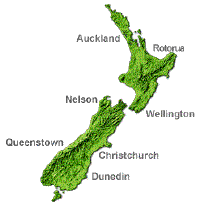 The New Zealand Public Health Association has urged the New Zealand Parliament's Finance and Expenditure Committee to rigorously assess the wider impact of government policies.
Dr Bichan urged Government to fully assess the health impacts of various policies, saying that health impact assessment tools were available to policy-makers. By considering the impact of a policy on the health of children and families, the Government could be alerted to any unintended negative consequences of that policy, such as some groups slipping further into poverty, and experiencing poorer health.The HIA tools mentioned include the Guide to HIA: A Policy Tool for New Zealand which was release by the Public Health Advisory Committee in 2004. It's quite a well structured document and is worthwhile reading for those with an interest in using HIA on policies.
Source
14 February 2006
Opportunities to Present on HIA (in Australia)
The closing date for abstracts for a number of HIA-related Australian conferences are approaching:
International Society for Equity in Health Conference: Creating Healthy Societies through Inclusion and Equity
Adelaide 11-13 September 2006
Abstracts due 11 March 2006
http://www.iseqh.org
The deadlines for abstract submission for a number of Australian HIA-related conferences are approaching:
Health Promotion Symposium: Getting Evidence into Practice
Sydney 28-29 June 2006
Abstracts due 31 March 2006
For more information email hpsymposium@swahs.health.nsw.gov.au
Public Health Association of Australia Conference: Tackling the Determinants of Health
Sydney 25-27 September 2006
Abstracts due 1 April 2006
http://www.phaa.net.au/conferences/Annual06/callforpapers.htm
It's unusual to have so many opportunities to present HIA-related work in Australia so I urge you all to make the most of it.
International Society for Equity in Health Conference: Creating Healthy Societies through Inclusion and Equity
Adelaide 11-13 September 2006
Abstracts due 11 March 2006
http://www.iseqh.org
The deadlines for abstract submission for a number of Australian HIA-related conferences are approaching:
Health Promotion Symposium: Getting Evidence into Practice
Sydney 28-29 June 2006
Abstracts due 31 March 2006
For more information email hpsymposium@swahs.health.nsw.gov.au
Public Health Association of Australia Conference: Tackling the Determinants of Health
Sydney 25-27 September 2006
Abstracts due 1 April 2006
http://www.phaa.net.au/conferences/Annual06/callforpapers.htm
It's unusual to have so many opportunities to present HIA-related work in Australia so I urge you all to make the most of it.
11 February 2006
Bungendore in the News
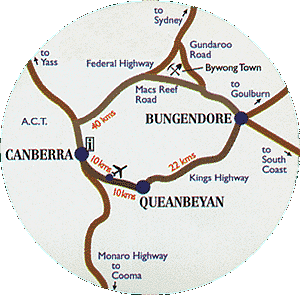 Bungendore, a village 35 km east of Canberra, has been in the news recently following the release of a Water Discussion Paper by Palerang Council. The discussion paper highlights some of the major challenges Bungendore faces in sustaining population growth and a sufficient water supply.
A HIA of the Bungendore's population growth planning is currently being undertaken as one of the 2005 Developmental sites. To find out more about the HIA access the article in the HIA E-News or you can take a look at the presentation on the HIA given at CHETRE's Health and Urban Development Workshop in December.
10 February 2006
Maplecroft Global Information Maps
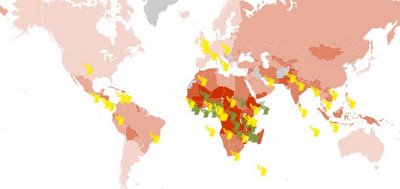
Maplecroft Maps has quite an interesting series of maps that cover a range of determinants of health issues:
- Poverty
- Education
- Digital Divide
- HIV/AIDS
- Malaria
- Tuberculosis
- Development Assistance
- Corruption and Transparency - salient when we consider that HIA is about influencing decisions and increasing transparency.
9 February 2006
Growing the Field of HIA in the USA
The American Journal of Public Health has published an a piece on Growing the Field of Health Impact Assessment in the United States. The article is based on a workshop held in October 2004 that brought together US and international practitioners, government agency representatives and academics with an interest in HIA.
The article is interesting because canvasses a number of debates around HIA's use, reminding me of many of the issues that CHETRE had to consider during Phase 1 of the NSW HIA Project.
The article's abstract is available after the jump.
Growing the Field of Health Impact Assessment in the United States: An Agenda for Research and Practice
American Journal of Public Health, 96(2): 262-270, 2006.
Authors: Andrew L. Dannenberg, MD, MPH, Rajiv Bhatia, MD, MPH, Brian L. Cole, DrPH, Carlos Dora, PhD, Jonathan E. Fielding, MD, MPH, Katherine Kraft, PhD, Diane McClymont-Peace, MS, Jennifer Mindell, MBBS, PhD, FFPH, Chinwe Onyekere, MPH, James A. Roberts, PhD, CEP, Catherine L. Ross, PhD, Candace D. Rutt, PhD, Alex Scott-Samuel, MB, ChB, MCommH and Hugh H. Tilson, MD, DrPH
Health impact assessment (HIA) methods are used to evaluate the impact on health of policies and projects in community design, transportation planning, and other areas outside traditional public health concerns. At an October 2004 workshop, domestic and international experts explored issues associated with advancing the use of HIA methods by local health departments, planning commissions, and other decisionmakers in the United States.
Workshop participants recommended conducting pilot tests of existing HIA tools, developing a database of health impacts of common projects and policies, developing resources for HIA use, building workforce capacity to conduct HIAs, and evaluating HIAs. HIA methods can influence decisionmakers to adjust policies and projects to maximize benefits and minimize harm to the public’s health.
Access the article
The article is interesting because canvasses a number of debates around HIA's use, reminding me of many of the issues that CHETRE had to consider during Phase 1 of the NSW HIA Project.
The article's abstract is available after the jump.
Growing the Field of Health Impact Assessment in the United States: An Agenda for Research and Practice
American Journal of Public Health, 96(2): 262-270, 2006.
Authors: Andrew L. Dannenberg, MD, MPH, Rajiv Bhatia, MD, MPH, Brian L. Cole, DrPH, Carlos Dora, PhD, Jonathan E. Fielding, MD, MPH, Katherine Kraft, PhD, Diane McClymont-Peace, MS, Jennifer Mindell, MBBS, PhD, FFPH, Chinwe Onyekere, MPH, James A. Roberts, PhD, CEP, Catherine L. Ross, PhD, Candace D. Rutt, PhD, Alex Scott-Samuel, MB, ChB, MCommH and Hugh H. Tilson, MD, DrPH
Health impact assessment (HIA) methods are used to evaluate the impact on health of policies and projects in community design, transportation planning, and other areas outside traditional public health concerns. At an October 2004 workshop, domestic and international experts explored issues associated with advancing the use of HIA methods by local health departments, planning commissions, and other decisionmakers in the United States.
Workshop participants recommended conducting pilot tests of existing HIA tools, developing a database of health impacts of common projects and policies, developing resources for HIA use, building workforce capacity to conduct HIAs, and evaluating HIAs. HIA methods can influence decisionmakers to adjust policies and projects to maximize benefits and minimize harm to the public’s health.
Access the article
8 February 2006
Welsh coal mining HIA urges precautionary approach
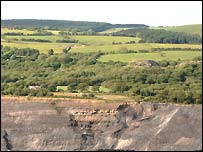 A HIA recently completed by the Welsh Health Impact Assessment Support Unit has urged planners to apply the precautionary principle in denying approval to a coal mine expansion. Whilst the assessors could not be certain about magnitude or severity of negative health impacts arising from the proposed expansion of an opencast coal mine in south west Wales they have urged planning authorities to reject the proposal:
"On balance, there is sufficient uncertainty regarding the negative health impacts to apply the 'precautionary principle approach' - which would not allow mining to proceed in such close proximity to residential areas."
Further details are available on the BBC News website.
Update 2 March 2006
I think that Carolyn Lester will be speaking about this HIA at the upcoming HIA conference in Wales. One more reason to attend.
7 February 2006
Upcoming Social Impact Assessment Training
It's not HIA-specific but the social impact assesssment training run by Rabel Burdge is still quite relevant to people with an interest in HIA. He's returning to Australia to run a series of courses in Queensland in March and in Queensland and New South Wales in August: (more information)
March 15-16
Eco-Centre building on the Griffith University campus in Nathan, Brisbane, Australia.
March 20-21
Robertson Gardens-Comfort Inn Hotel in Robertson at 281 Kessels Road, Brisbane, Australia
May 21-22
Stavanger Forum, Conference and Exhibition Center in Stavanger, Norway, in conjunction with the annual meeting of the International Association for Impact Assessment (IAIA).
June 8-9
Conference Centre at the University of British Columbia, Vancouver, BC, Canada, in conjunction with the 12th International Symposium on Society and Resource Management (ISSRM).
June 25 (one day only)
Sheraton City Centre Hotel, in St. Louis, Missouri (USA) in conjunction with the annual conference of the Community Development Society.
August 17-18
Eco-Centre building on the Griffith University campus in Nathan, Brisbane, Australia.
August 21-22
Wesley Conference Centre, 220 Pitt Street in downtown, Sydney, Australia.
November 10-11
Hyatt Regency Montreal Centre-Ville, Montreal, Quebec, Canada in conjunction with the annual meeting of the International Association for Public Participation (IAP2).
I did Rabel's course last year and found it very helpful. I've also used the course materials quite a bit subsequently. If you're interested in finding out more you can access the website or email Rabel at burdge@cc.wwu.edu
March 15-16
Eco-Centre building on the Griffith University campus in Nathan, Brisbane, Australia.
March 20-21
Robertson Gardens-Comfort Inn Hotel in Robertson at 281 Kessels Road, Brisbane, Australia
May 21-22
Stavanger Forum, Conference and Exhibition Center in Stavanger, Norway, in conjunction with the annual meeting of the International Association for Impact Assessment (IAIA).
June 8-9
Conference Centre at the University of British Columbia, Vancouver, BC, Canada, in conjunction with the 12th International Symposium on Society and Resource Management (ISSRM).
June 25 (one day only)
Sheraton City Centre Hotel, in St. Louis, Missouri (USA) in conjunction with the annual conference of the Community Development Society.
August 17-18
Eco-Centre building on the Griffith University campus in Nathan, Brisbane, Australia.
August 21-22
Wesley Conference Centre, 220 Pitt Street in downtown, Sydney, Australia.
November 10-11
Hyatt Regency Montreal Centre-Ville, Montreal, Quebec, Canada in conjunction with the annual meeting of the International Association for Public Participation (IAP2).
I did Rabel's course last year and found it very helpful. I've also used the course materials quite a bit subsequently. If you're interested in finding out more you can access the website or email Rabel at burdge@cc.wwu.edu
Subscribe to:
Posts (Atom)