19 February 2007

Developers and Businesses: HIA's forgotten stakeholders

Business Angels by bubbo-tubboI work with developers and businesses every day and there are times when it can be frustrating to get them to understand why they need to consider health and wellbeing issues beyond occupational health and safety. But often they do engage and do listen though they don't immediately jump to doing HIAs they are thoughtful enough to ask pertinent questions.

One of the most striking things about international policy and practice around project-level HIAs is the complete absence of discussion and debate about how we engage with developers and businesses. For me, they are 'HIA's forgotten stakeholders' or perhaps they are the proverbial 'elephant in the room' everyone knows they're there but doesn't want to look at them or discuss their presence.

Developers are seen as being, and sometimes can be, obstructive and hostile to HIA and its ethos. But often the fault lies as much with us in the public health and HIA community as with developers and businesses. We espouse values of openness and transparency but that seems to extend only to communities, NGOs and public institutions. We see developers as antagonists rather than fellow protagonists in the HIA drama. Society's 'villains' rather than its 'heroes'.

Often we don't even see them as stakeholders, let alone important stakeholders, in the HIA process. And in some cases, apart from wanting to access their environmental and health information, they are actively excluded from the process.

Quite rightly, there are concerns that developers, and businesses in general, have considerable financial power and political influence but we in the HIA community should not be afraid to engage, discuss and debate with them.

We need to be more active in educating, persuading and lobbying these key stakeholders about HIA, it value and how they can become enthusiastic and co-operative partners in the HIA process. Okay, so some of you are going to say 'Enthusiastic partners, never gonna happen!'. Maybe so, but with corporate social responsibility, ethical funds and sustainable actions growing in prominence developers and businesses are beginning to understand that need to grapple with the health and wellbeing implications of their plans and projects.

The lack of an active engagement programme, anywhere in the world, that reaches out to and engages with this group is startling and a critical weakness of current HIA policy and practice. Why so? Because ultimately it is businesses and local communities who tend to foot the bill for HIAs either directly or through taxes.

Having a proactive engagement process with developers and businesses has more pros than cons if we are strong in our values. It is only by proactively engaging with them and winning them over that we can transform their vision of the world and the free market to include health and wellbeing - alongside sustainability and the environment - as a critical factor in enhancing their business success.

Lastly, if Greenpeace and Friends of the Earth can do it why shouldn't and why can't we?

23 January 2007

Post-Normal Science, Community Knowledge and HIA


Post-normal science is a philosophical framework which argues that when normal science cannot predict future consequences with any degree of certainty and decisions with a strong social and political dimension need to be made, i.e. when facts are uncertain and decisions urgent, then using an extended peer community of affected stakeholders to review and ‘quality assure’ the facts and help develop a consensus way forward leads to more accurate and robust scientific decision-making.

Post normal science argues that 'normal' science works best when the uncertainty is limited and the importance of the decision is low. In such contexts the 'technical' uncertainty is reduced by using statistics. When uncertainty is greater and the decision stakes higher then professional judgement and consensus are used to reduce the uncertainty (alongside statistics). However, in contexts with high uncertainty and high decision stakes statistics and professional consensus are not enough. In these situations creating a larger peer review community made up of both professionals and lay people is also needed to 'quality assure' and enhance the accuracy and robustness of the predictions, judgements and decisions made.

What are the implications of this for HIA practice?

HIA involves the prediction of health and wellbeing impacts of a diverse group of individuals and communities, via compex pathways and over long periods of time. This high uncertainty is often married to high stakes local and regional or national decision-making e.g. the siting of waste and major other facilities.

The primary goal of community engagement in HIA is therefore less about consulting, involving or empowering (though these are important objectives in themselves) and more about uncovering the localised experiential knowledge base that communities have about both the existing negative impacts in their neighbourhoods and the potential impacts that might emerge if a proposed plan, programme or project is implemented.

Communities have valuable experiential knowledge about how their comunities work and how projects and plans have fared in the past that is crucial to gaining a holistic understanding of the potential health and wellbeing impacts. However, it is not enough or scientifcally acceptable just to ask communities about what they would like and what they think the positive and negative health impacts might be of a plan or project; but also - and more importantly - why they think so and what evidence they have that what they say is likely to happen.

HIA practitioners need to weigh up and evaluate this community evidence and assess its worth just as they would do with any other form of evidence. Who is saying what and why, how long have they lived in the area, do they cite examples and provide evidence that can be verified through other sources, how much agreement and disagreement is their between individual members of a community and on what issues.

Community evidence can therefore be critically reviewed in much the same way that other scientific evidence is reviewed and evidence review structures need to be developed to accommodate this kind of evidence. Post-normal science provides the foundations for developing such structures and processes.

Post-normal science makes it scientifcally possible to incorporate community experiential knowledge into the HIA process and provide justification for the importance of community knowledge and how this knowledge makes impact assessments more robust, rigourous and relevant.

8 December 2006

Who's afraid of community consultation?

Consulting local communities and other stakeholders as part of developing new plans and projects can be a difficult process. But it needn’t be so.

Communities are not scary, incomprehensible and unpredictable aliens from outer space! They are just like you and me. They have the same aspirations and dreams and the same worries and anxieties for their families and neighbourhoods that we all have.

Here are twenty top tips to help you make community consultation a rewarding, involving and engaging experience.

Do:
  • Know your audience.
  • Make sure you know why you are consulting, engaging or involving.
  • Make sure you let everyone else know why you are consulting, engaging or involving.
  • Be truthful even if that means saying “I don’t know”.
  • Then find out what you don't know and get back to them with an answer.
  • Be yourself.
  • Plan for how things might go wrong.
  • Smile, make eye contact and be warm.
  • Recognise that consultation and involvement generates uncertainty and unpredictability – for you and them.
  • Listen, listen and listen.
Don’t:
  • Ever promise what you can’t deliver.
  • Start consulting without getting agreement on a clear plan of action.
  • Assume that everyone in the team knows what they’re supposed to be doing.
  • Be disrespectful to people or their views.
  • Lose your cool.
  • Walk away leaving people feeling dissatisfied or aggrieved.
  • Finish the consultation without letting people know what the next steps are.
  • Get scared. Each consultation is unique and we all make mistakes.
  • Take comments at face value. If you have the chance, ask people why they’ve said what they have and what evidence they have to support it.
  • Forget to say “Thank you”.
Further Information: A Ladder of Citizen Participation - Sherry R Arnstein

29 November 2006

Cost Benefit Analysis of HIA


The UK Department of Health has published a cost benefit analsysis of HIA. From the abstract:

"The report sets out the findings of the cost benefit evaluation of Health Impact Assessment. York Health Economics Consortium followed 16 HIAs looking at the process, impact, outcomes and costs and benefits of HIA. The findings show the benefits outweigh the costs, although it was a small sample. The report will be subject to further consideration and comments are welcome."

Many of the issues identified in the report will be familiar to HIA practitioners. What is perhaps most interesting is the large variation in the amounts spent on conducting the HIAs - ranging from £1,107 to £65,240.

24 November 2006

Where does HIA fit best within the policy and planning cycle?

I’d like to stimulate some debate about where people see HIA best fitting within the planning cycle (following on from the interesting recent blog discussion on HIA as a scientific tool).

In New South Wales, HIA is seen as adding most value as a prospective tool at a specific point in the planning cycle; after a draft proposal has been developed but before implementation.

However, recently we’ve been approached to use HIA as a tool to assist with planning for health earlier in the cycle. This raises a number of issues:

First, should or can HIA be a substitute for good needs assessment and problem identification? Or can HIA become a useful needs assessment / problem identification tool? Work with communities on regeneration projects in Victoria has indicated this may be the case.

Second, developing a draft proposal takes time and effort. How can HIA be integrated with this time and effort while planning decisions are being made rather than afterward as a check on those decisions? Would this be a better way of ensuring health impacts are considered? At a recent training course Ben and I attended in Thailand, it was suggested that HIA can stretch itself earlier in the planning cycle to assist with developing different options and their potential impacts before the proposal is drafted.

Third, what are some other approaches and methods the HIA can use or add to earlier on in the planning cycle? For example, at a recent meeting we had with Urban Planners, it was suggested that as Health professionals we need to understand how private sector developers plan and develop proposals (i.e. through market analysis).

Finally, while I am open to HIA being used earlier in the planning cycle, I would take more convincing concerning the use of HIA as a retrospective tool that replaces evaluation.

What do others think?

10 November 2006

Will the HIA wiki replace existing HIA websites?

There's an interesting debate taking place over at the HIA Wiki at the moment about the future of HIA websites around the world. Take a look at the discussion and take a few moments to add your point of view.

22 September 2006

New Zealand inlcudes commitment to HIA in childhood obesity prevention strategy

New Zealand Prime Minister Helen Clark yesterday announced that policy HIA will be included as part of a portfolio of initiatives aimed at childhood obesity prevention
We are here today to launch Mission-On, a new $67 million government-wide package of initiatives to help New Zealand's children and young people become healthier, so they can lead active and successful lives.

...Finally, policy makers will be required to carry out health impact assessments when developing new policy and legislation.

Read speech in full

It will be interesting to see how this commitment to HIA develops in practice. The New Zealand Public Health Advisory Committee has developed guidelines on policy HIA which will be readily applicable.

Media Coverage of the Mission-On launch
Helen Clarks' Speech (Scoop)
Opposition Response (Stuff)
Unhealthy Foods Get Chop from Tuck Shops (NZ Herald)
Launch of $67 Million Campaign to Fight Obesity (Radio New Zealand
Campaign Pressures Schools Over Junk Food (Bay of Plenty Times)

20 September 2006

Health in All Policies: New publication from the Finnish Ministry of Social Affairs and Health

The mark the Finnish presidency of the European Union (as we've mentioned before) the Finnish Ministry of Social Affairs and Health has published a book entitled Health in All Policies: Prospects and potentials [PDF 1.9 Mb]. The publication presents a number of examples of "health in All policies" in sectors such as education, the environment, water and sanitation, planning, labour, housing, traffic, agriculture and nutrition.

The book has five sections:
  • Health in All Policies: The wider context
  • Sectoral Experiences
  • Governance
  • Health Impact Assessment
  • Conclusions and the Way Forward

15 September 2006

HIA: What's new on the web?

The London Health Observatory has released a Guide to Reviewing Published Evidence for Use in Health Impact Assessment. The guide has been through quite a rigorous testing and peer-review process and a revised edition, incorporating user-feedback, is planned for 2008. I haven't had a chance to use if yet and I'd be interested to hear about your experiences using it.

The European Public Health Alliance has an interesting page comparing the health impact assessments that have been done on US and European food and agricultural policies.

Mary Mahoney, from the Deakin University HIA Unit, recently spoke about a retrospective HIA that she has undertaken on drought relief in rural Victoria in Australia. The ABC has a page with details on the conference and Mary's HIA, along with an MP3 file of their interview with Mary (MP3, 1.6 Mb).

7 September 2006

Is HIA a Science?

About six months ago, I re-read the Merseyside Guidelines, the leading guidance on HIA in the UK. It's the guidance that every practioner in the UK, and I'm one of them, has read or says they've read. Okay, so first time round I read them quite quickly and I liked what I read. What I hadn't done three years ago, when I was a novice HIA practitioner still learning the ropes, was to read them critically. That's what I did second time around. Imagine my shock, as a signed up champion of science, when on re-reading them I found, at the back, this definition of HIA:
"Is health impact assessment a science?
It is important to emphasise that HIA is not strictly a science.
Having said this, it most certainly draws on a scientific knowledge base.
Scientific evidence on health impacts of specific determinants forms the backbone of this creative, interdisciplinary form of enquiry.
But each HIA is uniquely located in time, space and local conditions though its evidence base can be evaluated, and the rigour with which procedures and methods were implemented can (and should) be assessed.
Uncertainties encountered during the undertaking of HIAs will frequently dictate the need to make assumptions, which may result in challenges to the HIA’s validity: such assumptions are acceptable as long as they are stated explicitly, so that the reader is free to agree or disagree. ”
I agree with every part of this quote except the phrase "HIA is not strictly a science" because for me it describes perfectly what it means to apply scientific knowledge to the real world outside the lab.

For me, both HIA and science in all its myriad forms are "interdisciplinary forms of enquiry"; to misquote John Donne 'No science is an island entire unto itself every science is a piece of the continent, a part of the main'.

HIA for me is:

1. a systematic endeavour;
2. it uses knowledge and methods from other scientific disciplines e.g. epidemiology, sociology, toxicology and biology;
3. it aims for rigour,
4. it actively avoids bias and confounding;
5. the findings of one HIA have some applicability to communities of a similar social and cultural mix as that studied by the HIA; and
6. its results are subject to revision when new evidence or information comes to light that contradicts and refutes previous knowledge.

For me, this quote illustrates a misreading of science as about numbers and quantitative findings and about universal laws that transcend time and space. That works for the physical world (most of the time) but doesn't work so well for our social and cultural worlds where general laws and theories need to take account of local context. In fact even the universal laws of physics have to take account of local context. Science is about systematic enquiry where the resulting knowledge is always provional and subject to revision.

What's even more interesting is that environmental impact assessment practitioners don't have any qualms about calling EIA a science. Neither do economists or sociologists.

But public health professionals and HIA practitioners, in my experience, seem to have a problem with saying that HIA is a public health science? Or maybe I've got it wrong?

22 August 2006

Health Impacts of the Built Environment

The Institute for Public Health in Ireland has released a review on the health impacts of the built environment, complementing their earlier reviews of the health impacts of employment and transport. The review provides a useful basis for understanding the range of health impacts that may arise in relation to the built environment, though the lack of contextually-specific detail may make it more useful as a document that guides scoping.

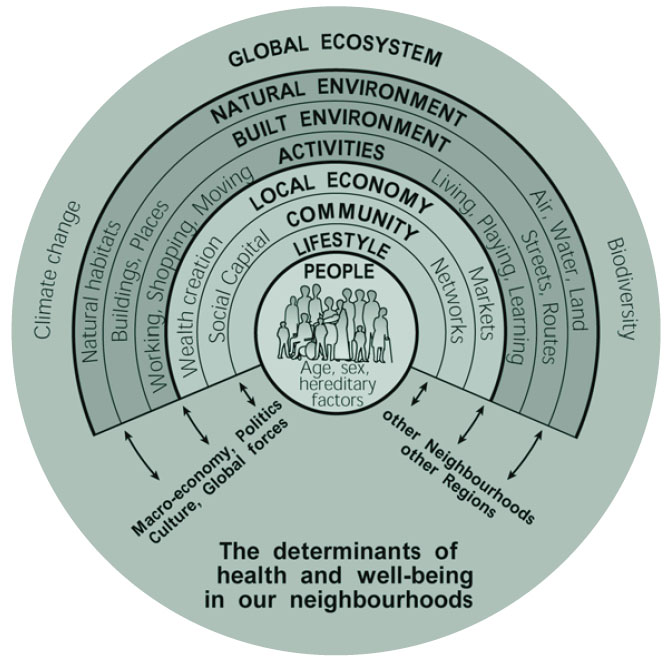
The review includes the version of the determinants of health diagram developed by Goran Dahlgren and Margaret Whitehead that has been adapted by Barton and Grant to include a planning perspective. What I think is missing from the model is the important role health services still play in determining health outcomes, though their absence may be understandable given the audience for whom the diagram was adapted (land use planners, social planners, local government, etc).

I'm reminded of McKee's (2002) observation that McKeown's influence on public health was to popularise the view that improvements in mortality were mostly due to improvements in living conditions (McKeown 1979). Mackenbach and his colleagues refuted this, at least in part, by demonstrating the decline in deaths from conditions that could be altered through health care represented a major part of overall improvement in life expectancy in The Netherlands between 1950 and 1984 (Mackenbach et al 1988).

I think there's still an important role for health services in contributing to a reduction in health inequalities and ensuring population health gains. What do you think?

References
Mackenbach J, Looman C, Kunst A, Habbema D, van der Maas (1988) Post-1950 mortality trends and medical care: gains in life expectancy due to declines in mortality from conditions amenable to medical interven-tion in The Netherlands. Social Science and Medicine 27:889-894.

McKee M (2002) What can Health Services Contribute to the Reduction of Inequalities in Health?, Scandanavian Journal of Public Health, 30(Supplement 59) p 54-58.

McKeown T (1979) The role of medicine: dream, mirage or nemesis? Oxford: Blackwell.

17 August 2006

Monitoring and Evaluation

An excellent introduction to monitoring and evaluation has been released by the World Bank:


Monitoring and Evaluation Report

This is a useful resource for anyone considering monitoring and evaluation approaches, tools and strategies as part of their HIA (or broader work). The booklet covers performance indicators, the logical framework approach, theory surveys, rapid appraisal methods, participatory methods, public expenditure tracking surveys, cost-benefit and cost-effectiveness analysis, and impact evaluation. Each has a section to itself that covers what each is, what each is used for, advantages, disadvantages, costs, skills and time required, and links to other websites and resources. Using the booklet would certainly help people to quickly and concisely scope the most appropriate approach to the monitoring and evaluation stage of their HIA (the least well covered stage in the HIA guidance literature).

27 June 2006

Health Impact Assessment Wikis

Wikis are website that allow any user to update and edit the information they contain. The biggest and best known wiki is Wikipedia, an ambitious free web-based encyclopedia project with over 1.2 billion articles in English.

Of interest to HIA practtioners are the HIA Wiki, which was started by Salim Vohra, and the HIA page on Wikipedia. You can use these not only as a source information but also as a vehicle for updating others on HIA-related developments.

A number of people have expressed concerns about wikis' unmoderated nature. I think that when using a wiki it's important to view the page history to assess if what you're reading is the result of informed and constructive contributions. The other thing to keep in mind is that even with traditional mediums such as books and journals the editorial and peer-review processes aren't rock-solid guarantees of quality. Critical appraisal has always been important.

Please take a look at both wikis. I'd be interested in your impressions of them.

23 June 2006

Should population health studies be called HIAs?

I was reading through a report in today's Courier Mail (Brisbane, Australia) about an industrial estate in Queensland that's causing a bit of controversy. The local community has been concerned about the health impacts of a chemical fire that occurred in one of the estate's factories nine months ago, and the ongoing risks the industrial estate poses for their health.

In the article the Premier is reported as saying that a HIA will be undertaken as part of his plan for the site. The article isn't entirely clear about what the HIA will be done on - the impact of the fire nine months ago or the possible health impacts of relocating the four businesses identified by the government as being unsuitable for the industrial area. I get the impression that it's the former because it's described as "a full health impact assessment and full scientific study conducted with independent consultants".

This made me wonder, should this sort of activity be called HIA?

My gut response is that it shouldn't. It doesn't follow the steps of HIA and it doesn't necessarily involve looking at the determinants of health (instead often focusing on measuring health outcomes). This issue has come up in the past, with people calling a variety of population health-related research activities health impact assessment (see Kemm 2003, PDF 38Kb - particularly the discussion of retrospective and concurrent HIA).

What do you think about these sort of studies being called HIAs?

References
Kemm J. Perspectives on Health Impact Assessment, Bulletin of the World Health Organization 81(6):387. Available from http://www.who.int/entity/bulletin/volumes/81/6/kemm.pdf

14 June 2006

New HIA Guidance from Ireland

The Institute for Public Health in Ireland has produced an interesting set of guidance on HIA. I like the way there are a number of case studies included in the appendices, helping to ground the guidance in the real-world experience of HIA.

What's your take on the publication?